

What if we could redesign the Internet? In this interview with MediaWell, critical informatics scholar Britt Paris discusses her new book Radical Infrastructure: Imagining the Internet from the Ground Up (University of California Press, 2026) — a timely glimpse into opportunities for a different, more people-centered digital future.
Can you explain what you mean by “Internet infrastructures”? How do the different layers of Internet infrastructure shape how people experience the Internet?
This book is very heavily grounded in science and technology studies, but I like to consider myself an infrastructural scholar. So within that frame, infrastructure refers to physical things: we’re often talking about technological apparatuses. With regard to Internet infrastructure, we’re talking about physical things like fiber, cables, routers, you know, various material substrates of Internet connectivity. But it also refers to the way that people make these materials useful, meaningful, operable, and allows them to coordinate with others in their daily lives. The way that this usually happens in a number of different ways, but broadly through policy, labor, and use.
So this book is about Internet infrastructure, but in a lot of ways, it’s about how technology interacts with various types of infrastructural concerns, and how technology and other types of infrastructure become deeply entangled with some of the most pressing crises of our time. It’s about how these infrastructural concerns that we see sort of popping up or rising from time to time are not inevitable and they’re not neutral. Rather, they are a result of the fact that these infrastructures are material, that they are social, that they are material and social at the same time, both in terms of their tangibility and in relationship to political and economic concerns. For example, Internet infrastructure is built on minerals, labor, fuel, and physical material – things like anything else. I argue that these are sites of struggle, and as I illustrate in the cases in the book, they’re engaged politically.
When most people think about the Internet, they think about the application layer. They’re thinking about platforms like Meta, X, and Google. Which makes sense, because those are the most visible user-facing components of the Internet. These application layer concerns are really a very useful and tempting point of entry for public debate around the Internet and the Internet’s future, because they’re so familiar and easily legible.
But this book argues that meaningful engagement with these problems that we see and are very palpable at the application layer requires us to dig much deeper into these layers of material and social coordination. I use this International Standards Organization (ISO) protological stack in each case throughout the book to talk about how each group within the book engages various infrastructural layers. So various layers of material and social coordination in their work or in the practices that I’m talking about in that particular chapter. I really want to highlight that in each chapter, I talk about how people and the organizations involved with these projects have concerns that sort of run up and down the stack.

Source: Britt Paris, Radical Infrastructure
So from the data link layer, where fiber is laid and being tacked into so that Internet traffic can be discretized as zeros and ones, and flow through Internet protocol and make it to the application layer – these layers are not distinct in social and political practice. A lot of the time they’re abstracted in technical practice. But I really want to highlight in this book that these protological layers, or Internet infrastructural layers, are not distinct. They’re a coordinated whole that people have to grapple with more in some than in part.
So that’s why I talk about the layers. We understand what’s going on at the application layer, and there are issues going on at the application layer that maybe we’re not happy with, or that we’ve seen worked differently in the past, and now they’re a complete mess, right? I want to highlight that within these deeper layers are the largely hidden material, political and economic practices that make the Internet function at all.
To understand what is going on at the application layer, you have to first understand what is happening at these deeper layers, and how a lot of these problems are produced elsewhere. What we see at the application layer is a symptom of things that are happening elsewhere in this protological stack.
What was your path towards writing this book?
In some ways, I’ve been writing this book since I was 10 years old, when I would go to local telephone cooperative meetings with my grandma and do local history research with her, or when I’d work on technical projects with my dad and grandpa. (When I’m talking about technical projects, I’m talking about working on a tractor and stuff like that.) My background trains me to think about how things are made and how people interact with physical things that they use to make meaning in their lives – the things that they use to engage with others, or that they use to function within capitalist systems in their lives. And I think about what governs how people interact with those things.
More concretely, this book started with my dissertation way back in 2015 or 2016. I’d been thinking about the Internet as an infrastructural project before that, but that’s definitely where I got my grounding and started doing a lot of the work on this topic. I’ve also been involved in activist projects around tech justice. I’ve been really paying attention to a lot of these issues that come up in the book very closely, and watching and tracking how they’ve changed and morphed and their trajectory over the last 15 years – since I’ve been working as a scholar, or an aspiring scholar in the very beginning. So that’s part of my trajectory.
But really, the need for this book in particular hit home in 2020, as I was teaching students over Zoom for my first time as a professor. It made me think back to when I was in high school in rural Northern Missouri in the early 2000s. Our local Internet cooperative or telecommunications cooperative provided fiber to our school to develop what was then – or what might be understood now as like a Zoom classroom – an ITV classroom, which was hardwired so that we could get college credit from people who were certified by community colleges to teach across local, rural, high school schools. So we could get college credit out of the way and all this nice stuff, and we had amazing teachers.
Back in 2020, I didn’t really know how to teach over Zoom, and I was not getting a whole lot of instruction on how to do this. So I was just thinking back to what those high school ITV classrooms looked like and how those classrooms were possible. This was at a time when people were being gouged for Internet service and platforms were changing all their terms of service during the pandemic, when everybody was forced online.
I really started thinking about a lot of the things that I was teaching in these classes – you know, a poisoned information ecology and the fact that big tech companies own and constrain everything we’re able to do online. I started thinking about my lived experience and a lot of the things that I was talking about to my students in these classes sort of in tandem. That’s how I started the book project – I sketched out my original idea for the book in the summer of 2020.
Were there any case studies in your book that stood out to you as particularly insightful or surprising, or have become more relevant over time?
I like them all. It’s hard to choose one because when I give talks about this book, I’m like, “Oh, what is going to be the case that this group of people I’m talking to is going to find the most interesting?” And it’s always really hard for me to choose. Maybe that’s because it’s a bit of a dealer’s choice conundrum where you’re like, well, I wrote this. I think it’s all very interesting, right?
But I think all of them had some interesting-yet-surprising turns that highlight what this book is it really about – the breathtaking overreach of corporations, private equity, technology companies, and their boosters and how they continually thwart ongoing activities around organizing in the Internet properly as a public service or something that would work for the people.
In the case in Missouri, these cooperatives are threatened by private equity that are buying up all manner of land and infrastructure connected to and surrounding these cooperative Internet enterprises. In Kentucky, crypto-mining outfits leech energy from the grid, drive up energy costs, and drive up Internet costs as well – and receive bipartisan support in doing so. Across the country, people are organizing for municipal Internet or municipal utilities. But entities, very powerful entities like Comcast, run expensive slander campaigns – you know, sue the pants off these organizations to stop them. In those areas, sometimes people want public service Internet, but more than that, they want things like health, economic, environmental, and racial justice – issues that are all intertwined with local fights around the top-down technology deployment.
All of these cases illustrate both the hope and ongoing activity and the ways that people are pushing for forward for better things when it comes to the sociotechnical sphere, but also how they engage with, negotiate with, and are thwarted by these massive obstacles that exist in the way of building a truly meaningful people-centered technology sphere that focuses on people’s well-being, and not just profits for a few people.
What do people-centered Internet projects look like? How do we know when something is people-centered vs. when it’s making empty promises (or falling short or those promises)?
So first, these projects should focus on people. Not on profits, not on return on investment, not on shareholder dividends. In the best case scenarios, like with some of the real cooperatives that I write about in the book, they are governed by the people who use them. They might even consider their users, in some senses, like stakeholders or shareholders in the good of the company. Just looking at the ownership structure helps a lot. Looking at the decision-making structure around various technical projects helps us understand what its focus is, right? Who’s making decisions and who benefits.
I think this gets to one of the main points of this book, thinking about people-centered infrastructure – folks talk about whether technology gets us to where we want to be, and how we can cure our uncritical assumption that, with technology, scale is something we necessarily want. Or is necessarily good.
And ultimately, I argue that if we’re serious about people-centered Internet infrastructure, we should focus on collectivizing and cooperativizing what we can – the deeper levels that are the guts of the Internet, and also cooperatize the application layer. And learn to do things in ways that don’t require massive data collection and connectivity, but rather collectivity, right? Focus on collectivity and cooperativity, not like it’s absolutely necessary to be connected at every minute of your life.
One of the main themes of the book is that the future of Internet infrastructures is undetermined; would you expand on what you mean by that?
In the cases in this book, I talk about how people are grappling with changes that are facing them every day with regard to Internet provision and Internet connectivity.
In different places around the world, cables are being destroyed because of warfare or because of environmental catastrophe. Policy is constantly changing. There are constantly ownership changes of different parts of technological infrastructure. It’s all always changing. And it’s always changing, for the most part, without our knowledge or involvement – but it doesn’t have to be that way.
Because Internet infrastructure isn’t something that regular people can’t or shouldn’t be interested in or involved with. It’s not necessarily technically difficult to understand. And that shouldn’t preclude people from taking a vested interest or an active part in shaping what the future of the Internet looks like – because it’s going to break, it is breaking, and it will continue to break if we do nothing.
In the last month or so, I’ve started to use this case in point: so we’re all very familiar now with the Strait of Hormuz. Obviously, it’s an international shipping lane, and given the West’s reliance – and particularly America’s reliance – on Big Oil, closing the strait of Hormuz affects us all. And it’s started to affect us in terms of energy prices and supply chains and all of these things, right? But there’s also massive veins of Internet fiber that runs beneath the Strait of Hormuz, which is being destroyed in various connection points as the U.S. attacks Iran. This cable connects Europe, Africa, and Asia with the rest of the world, right? So this is not speculative. This is happening in real time.
There’s more and more data about a growing dissatisfaction with social media and the current state of the Internet – and a lot of discussion about the need for something else, but not really knowing what those alternatives look like. How can Radical Infrastructure better guide those discussions?
I think it allows us to think beyond what has been. Or that’s what I hope – it allows us to think beyond this comfortable narrative that what we have is the only thing that can exist, or that will ever exist. It shows us that the Internet is continually breaking. People are continually making decisions about how the Internet will work, run, be priced, how it’ll be accessible or not accessible to different demographics of people. And people are also deciding to use it or not use it, and certain applications use it or don’t in particular ways.
We’re fed these lines [Internet infrastructure is] something that normal people can’t understand. I think that robs us of our agency in being able to push for something that we know we deserve, that we need, and that we can build.
So I really want to first highlight that things are always in flux. We’re fed these lines that we have no agency here because technology is just so complicated, or framed as something that normal people can’t understand, or that technical things are best left to technical experts. I think that robs us of our agency in being able to push for something that we know we deserve, that we need, and that we can build. It may not look like they want it to look, and it won’t make as much money as they might like it to make, right? But it might be better for all of us.
What I’m really trying to provide here is examples of groups who are doing something different – even if it’s not as radical as we might hope for. Change can be incremental. They may not be doing as much as we need them to do in this moment, but they do offer us glimpses of how things might be different. And that helps show us, I think, that things can be different, and do work differently in a lot of examples.
This is one of the reasons that I wanted to highlight a lot of this complexity in the ways that these groups negotiate with these gigantic capitalist forces that are constantly seeking to exploit and extract from their people-centered focus. It helps us understand when these alternatives are useful or when they’re full of shit.
Because I think getting at ownership and governance structures, as well as how they engage with community needs, tells us a lot of what we need to know with emerging technology projects or products. Or, say, venture capitalist funding, venture capitalist companies that come in and propose all of these solutions, and then offer nothing.
So I think this book shows us that there are ways forward. But also that most of these positive ways forward really grapple with the idea of technology at scale in exchange for thinking about localized, smaller-scale solutions of community-building – and solving more of our problems in that way, rather than just throwing technology at the problems.
It feels like a lot of people are becoming aware of Internet infrastructure and its stakes for the first time – for example, in light of conversations around AI data centers. For people entering these conversations for the first time, what else should they be thinking about, listening to, or reading?
I would say 404 Media is always doing great work and making it very legible for people who are not practiced scholars in these areas to really help highlight the stakes of a lot of these topics. Brian Merchant’s Blood in the Machine, too – he has a Substack that I think is really good and clearly articulated, where he does quick, grounded research, then reports it out in meaningful ways. I think it’s very compelling and very easily understood by folks who may not, again, be very well-versed to practice in these areas.
I could list off a litany of scholarly articles and scholarly publications – Dan Schiller’s Crossed Wires is a wonderful book. It’s very thick, if you get a physical copy, but it gives a really beautiful history of the U.S. Postal Service and how it’s connected to Internet provision, and how we think about Internet provision in this day and age. It’s a really wonderful historical, political, and economic engagement with how we got to where we’re at.
In my own book, I also work through a number of examples from fiction that help us that might help us understand where we’ve been and where we could go in the future – to sort of sketch out, number one, what are the stakes of allowing things to continue as they have been or allowing things to continue as some of the techno-feudalists would like it to continue? Or what if we were to develop, work for, and organize toward a meaningful, people-centered Internet and sociotechnical sphere?
Because, you know, what types of examples do we have to draw from? We have a lot of real historical examples of corporate-focused technology, even to some degree of state- and military-focused technology. But we really don’t have a lot of good and meaningful examples apart from the ones that I offer in the book, that are – at best – negotiations, socialist negotiations with a very deeply entrenched capitalist sociotechnical system.
So in that case, we have to draw from fiction. I think Kim Stanley Robinson’s Three Californias trilogy is really good there. I always love Ken Layne’s Dignity. Those are really good books that sort of sketch out how politics – and how infrastructural politics, if we want to think about it in those terms – might be otherwise. And how they are necessarily a practice, not something that we arrive at, right? It’s a constant struggle. Sort of like how hope is a constant struggle, right? So that’s the point of these books.
Across various regional, political, ideological, fill-in-the-blank divides – people can get behind the idea that our infrastructures should not be poisoning us.
One of the biggest challenges with any social media or technology research, I think, is that everything changes so quickly and constantly. Have there been any new developments since publication that you wanted to expand on, or have changed your analysis?
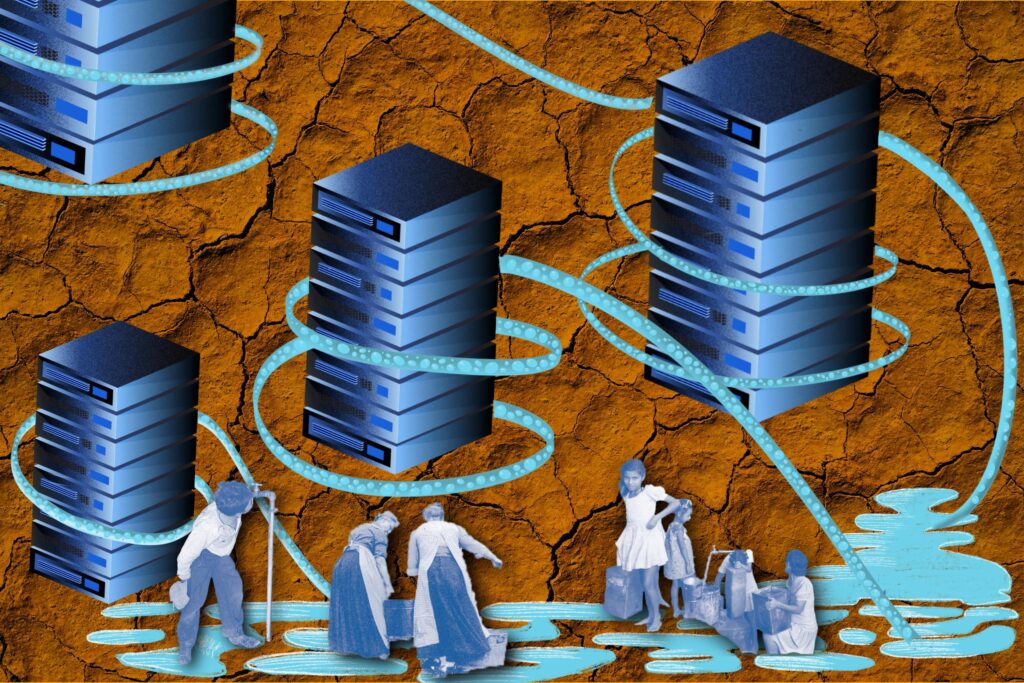
Yes. The data center pushback is something that I’ve been following, it’s just been wonderful to see. And it really highlights and speaks to a lot of what I’m talking about in the first chapter, where – across various regional, political, ideological, fill-in-the-blank divides that we sense in the country – people can get behind the idea that our infrastructures should not be poisoning us. Our infrastructures shouldn’t be extracting enormous resources or extorting us to enable bad technological products that seek to enrich the few and leave the rest of us to immiseration. So this data center pushback is interesting and useful – I love to see it.
The case in the book about cloud computing being tethered to physical infrastructural concerns of land, labor, and an extraction of those two things – that was the point right before the massive data center expansion across the country. It sort of captures the moment just before all the data center stuff started happening. And I think what’s illustrated in that chapter is still true and continues to happen.
But what we see with the data centers – unlike with the fulfillment centers or some of the nuclear energy pivots made by some of these cloud computing companies just a few years ago – we’re seeing massive pushbacks on these data centers because people see the stakes. People see their electricity bills rise. People see what is going on. And they won’t stand for it.
That’s something that has come to pass – not in the time since publication, but definitely since the substantive writing of this book that I think has really just driven home a lot of the arguments that I make in a nice way. And it gives us yet another case to focus on in thinking about where we might push, and how people are interested in pushing forward for people-centered infrastructure of all types.
What do you see as the areas for further work or research on this topic? What more has to be done, and what questions do you think should be explored next?
A lot of people are doing work on data centers. Data center pushback, what that looks like, and how people are trying to mobilize it right now.
But I think even as I was engaging with some folks for background or possible cases with this book, there’s a lot that I didn’t put in there. Because it’s not really my story to tell, right? There’s tons of really interesting work going on in the Global South around cooperativizing and collectivizing Internet exchange points – cooperativizing fiber, cable-laying, and distribution. There are indigenous groups in North America who have done really great work in this area of cooperative models. And within organized and non-organized labor, there are examples of alternative modes of networking and routing that folks have used to keep their communities safe and be able to communicate about organizing.
Daniel Mwesigwa, a researcher at Cornell, is writing about how people in Africa co-opt information infrastructures to do all of the types of things that they need when they’re not provided with the appropriate mechanisms of doing so. Similarly, Fernanda Rosa is doing this with Central and South America.
I think there are tons of ways to think about how people are negotiating with capitalist technology products and projects, and focusing more on community-run technical projects that focus on people and what they need – as opposed to thinking about just connectivity for connectivity’s sake, scale for scale’s sake. There’s a need to focus on cooperativity, and that technical solutions should not necessarily be the first avenue of attack – and so if they aren’t, what is meaningful? What do these community groups want? What do they build for? And how does technology and infrastructure support the community goals that they have around economic, environmental, and racial justice?
A free e-book of Radical Infrastructure is available through Luminos, University of California Press’s Open Access publishing program.
Banner image credit: Hanna Barakat & Archival Images of AI + AIxDESIGN / https://betterimagesofai.org / https://creativecommons.org/licenses/by/4.0/